A short history of the bookend
Part of the Book Hub: prints, bookmarks, gifts and guides in one place.
Where did bookends come from?
Pairs of objects made to hold books upright existed in Europe by the late 18th century. The Cooper Hewitt museum holds a French pair in gilt bronze and granite dated about 1780 (Wikipedia: Bookend).
Who patented the bookend?
William Stebbins Barnard of Canton, Illinois received a US patent, No. 186,974, in 1877 for a book support made of two unconnected angular end pieces, each held in place by the books standing on its base. We checked the record on Google Patents: it is titled "Improvement in book-supports" and carries a prior art date of 6 February 1877.
When did the word bookend appear?
Merriam-Webster dates the first known use of the noun bookend to 1907.
What happened in the 1920s and 1930s?
| When | What |
|---|---|
| Around 1920 | Bradley and Hubbard of Meriden, Connecticut made cast-iron bookends; mass production grew in the 1920s when many doorstop foundries also made bookends |
| 1929 | Albert Drexler Jacobson designed ceramic bookends for Cowan Pottery |
| 24 March 1931 | Arthur von Frankenberg received design patent D83,780, assigned to Frankart, Inc. |
| Around 1935 | Keith Murray designed an earthenware bookend for Wedgwood |
What are bookends made of?
Wood, stone, cast iron, bronze, copper, chrome, ceramic and glass, and sometimes a brick. Decorative bookends are common as home decor and can show something of the books they hold.
How do you choose bookends today?
Read how to choose bookends for weight, material and shelf size, then see the bookends we checked in the Amazon gifts section of the Book Hub. A framed book print next to a pair of bookends finishes a shelf.
Where to go next
- Up: the Book Hub, with book prints by book, gifts by price, Christmas order dates and every gift guide in one place.
- Next: 10 bookshelf styling ideas.
- Next: home library ideas for small spaces.
- Next: books turning 100 in 2027.
Sources (2)
All read on 20 November 2026 and written up here in our own words.
- Wikipedia: Bookend, the history and the later patents.
- Google Patents: US186974A, the 1877 Barnard patent record.
Worth following
More gifts for book lovers, from places we like. Tap a title, then a name.
Sites for readersWhere book lovers find the next book, and the next gift
GoodreadsFind and share books you love
Reading community
A site for finding and sharing the books you love, with reviews and reading lists from other readers.
Open Goodreads ↗Opens in a new tab. Independent of Chapter & Scene.
Book RiotRecommendations and reviews
Books site
Book Riot says it celebrates all things books, with recommendations and reviews for your next read or book club, in all genres.
Open Book Riot ↗Opens in a new tab. Independent of Chapter & Scene.
Literary HubThe best of the literary web
Literary site
A literary site that describes itself as the best of the literary web.
Open Literary Hub ↗Opens in a new tab. Independent of Chapter & Scene.
National Book TokensGift cards for book lovers
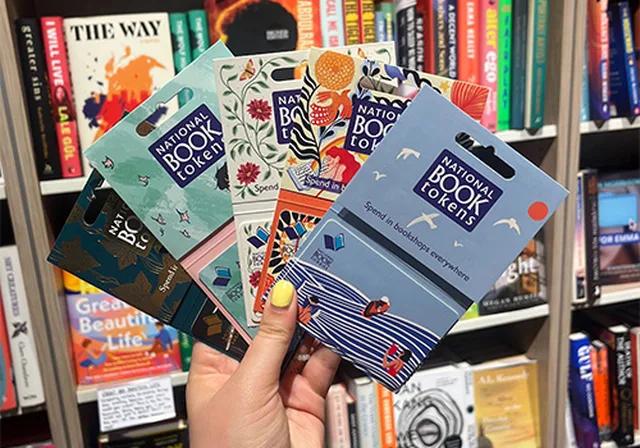
Gift cards
Gift cards for book lovers, accepted in bookshops in the UK and Ireland. A good answer when you do not know which book.
Open National Book Tokens ↗Opens in a new tab. Independent of Chapter & Scene.
World Book DayBooks, book tokens and free activities
Reading campaign
The UK and Ireland World Book Day site: books and book tokens, with free activities, costume ideas and reading fun for all ages.
Open World Book Day ↗Opens in a new tab. Independent of Chapter & Scene.
BookTrustGetting children reading
Children's reading charity
The UK's largest children's reading charity, which says it works to get children and families reading.
Open BookTrust ↗Opens in a new tab. Independent of Chapter & Scene.
Hay FestivalReaders and writers together
Festival
Hay Festival says it brings readers and writers together to share stories and ideas. It started in Hay-on-Wye, the Welsh town of books.
Open Hay Festival ↗Opens in a new tab. Independent of Chapter & Scene.
Penguin Books UKFind your next read
Publisher
The publisher's own site, for finding your next read and hearing from the authors you love.
Open Penguin Books UK ↗Opens in a new tab. Independent of Chapter & Scene.
Podcasts and radioFor the commute, the walk or the washing up
BacklistedGiving new life to old books
Podcast
The books podcast presented by John Mitchinson and Andy Miller, which gives new life to old books.
Open Backlisted ↗Opens in a new tab. Independent of Chapter & Scene.
Open BookNew fiction and non-fiction
BBC Radio 4
The BBC Radio 4 programme that looks at new fiction and non-fiction books.
Open Open Book ↗Opens in a new tab. Independent of Chapter & Scene.
BookclubReaders talk to authors
BBC Radio 4
Led by James Naughtie, readers talk to acclaimed authors about their best-known novels.
Open Bookclub ↗Opens in a new tab. Independent of Chapter & Scene.
Free reading and listeningSomething for the reader who has everything
LibriVoxFree public domain audiobooks
Free audiobooks
A library of free public domain audiobooks, read by volunteers. Handy for the classics, many of which we make prints from.
Open LibriVox ↗Opens in a new tab. Independent of Chapter & Scene.
Questions
Who invented the bookend?
William Stebbins Barnard of Canton, Illinois received a US patent for a book support of two unconnected angular end pieces in 1877. Pairs of objects to hold books upright existed in Europe by the late 18th century.
When was the word bookend first used?
Merriam-Webster dates the first known use of the noun bookend to 1907.