Mendeleev and the periodic table
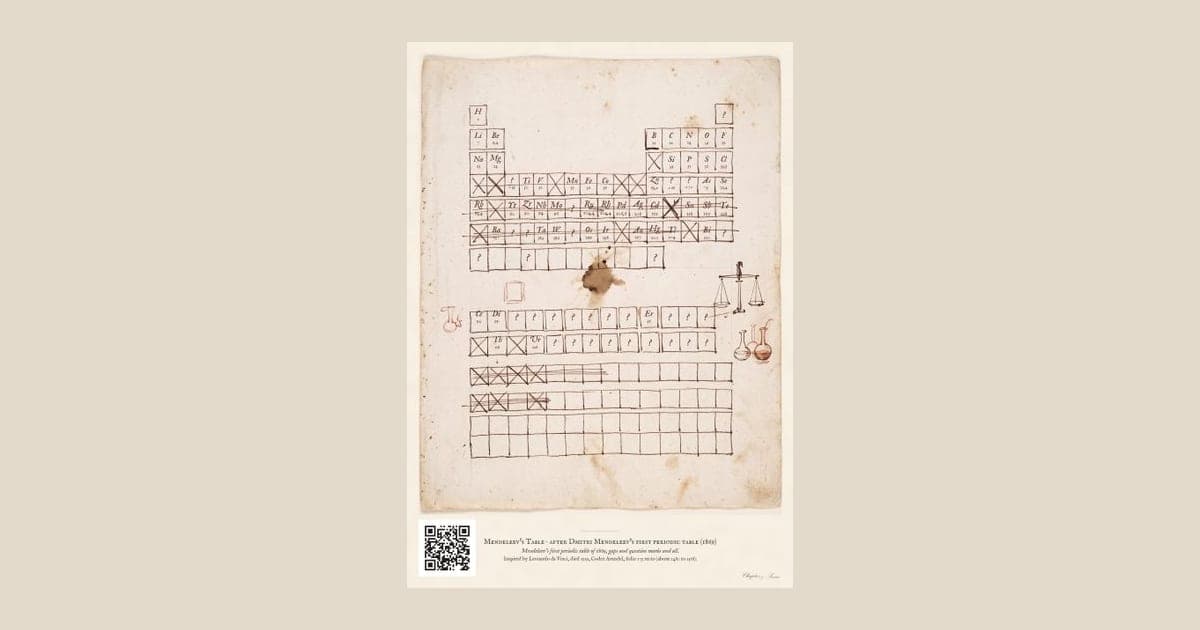
Every chemistry classroom has one on the wall. The periodic table is a chart of elements, and it is also one of the best predictions in the history of science. Here is the man who made it.
The problem
By the 1860s chemists had found about sixty elements, and no one could say how they fitted together. They knew the elements had different weights and that some behaved alike. What they did not have was a pattern.
Dmitri Mendeleev
Dmitri Mendeleev was a Russian chemist, born in Siberia in 1834, who taught at the University of St Petersburg. While writing a textbook in 1869, he began arranging the elements by atomic weight on cards, and found that the properties repeated at regular intervals. He published his periodic table that year.
The gaps were the genius
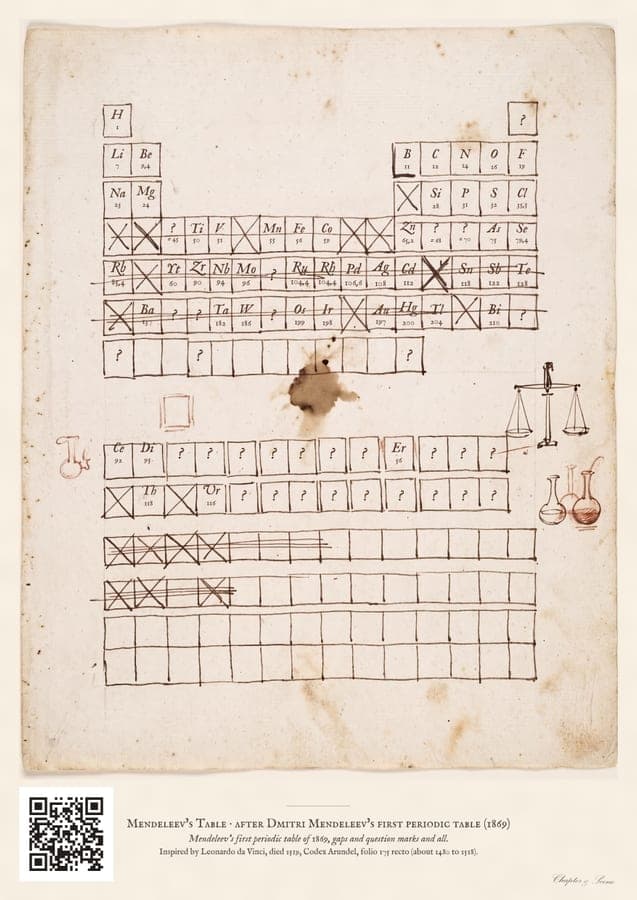
Mendeleev did not force the elements to fit. When the pattern said an element should be there and none was known, he left a gap and wrote a prediction. He gave three of the missing elements provisional names and described their weights and properties in detail.
And then he was right
Gallium was discovered in 1875, scandium in 1879 and germanium in 1886. Each matched his predictions closely, and chemists stopped asking whether the table was a curiosity. It was the map.
The story of the dream
Mendeleev is sometimes said to have seen the whole table in a dream. It makes a good story, but it was years of careful work. The truth is better: he was sorting cards and playing patience with the elements.
The print
Our Mendeleev's Table print is made for the classroom, the lab and the study: a chart you can look at every day.
For the science fan, see Christmas gifts for him.
Questions
- Who invented the periodic table?
- Dmitri Mendeleev published the first widely accepted periodic table in 1869, arranging the known elements by atomic weight and properties.
- Which elements did Mendeleev predict?
- He predicted three, which were later found as gallium (1875), scandium (1879) and germanium (1886).