The Nutcracker and the Mouse King: the story behind the ballet
Most people know The Nutcracker from the ballet. The story it came from is stranger, darker and funnier, and it was written for children over two hundred years ago. Here is where it began.
By Scout · Updated
In this article
01
Where the story comes from
The Nutcracker began as a short tale by the German writer E. T. A. Hoffmann, published in 1816 as "The Nutcracker and the Mouse King". Hoffmann was best known for writing eerie stories for adults, and you can feel it. A girl called Marie is given a plain wooden nutcracker on Christmas Eve, and that night her toys come to life and go to war with an army of mice.
02
The Mouse King has seven heads
In the ballet the Mouse King is a comic villain with one head. In Hoffmann's tale he has seven, each with a crown, and he is genuinely frightening. Marie is the one who saves the Nutcracker, and she does it with a shoe.
03
A tale within a tale
Hoffmann's story includes a second story, "The Tale of the Hard Nut", which explains how the Nutcracker came to be a wooden doll in the first place. It is a fairy tale about a curse and a princess, and it is why the Nutcracker is a prince.
04
From Hoffmann to Dumas to Tchaikovsky
In 1844 the French novelist Alexandre Dumas retold the story in a softer, more child-friendly version. That version reached Russia, and it was the one the choreographer Marius Petipa used. Tchaikovsky wrote the music, and the ballet opened at the Mariinsky Theatre in St Petersburg in December 1892. The heroine was renamed Clara.

05
How did the first Nutcracker go?
Not well. It opened at the Mariinsky on a double bill with Tchaikovsky's last opera, Iolanta. Petipa wrote the scenario and began the choreography, but illness forced him out and his assistant Lev Ivanov finished it. Critics complained about the plot, the number of children on stage and how late the ballerina appeared, though most liked the music.
The music had a head start. Tchaikovsky conducted a concert suite of eight numbers on 19 March 1892, nine months before the ballet. The celesta, a keyboard instrument that sounds like small bells, gives the Sugar Plum Fairy her variation: Petipa asked for music like drops of water shooting out of fountains (Royal Ballet and Opera).
Britain saw the whole ballet in 1934. The Vic-Wells Ballet, the company that became the Royal Ballet, gave the first complete Nutcracker outside Russia, staged by Nicholas Sergeyev from Petipa's choreography, with Alicia Markova as the Sugar Plum Fairy (English National Ballet, New York Public Library).
06
Why it belongs to Christmas
Hoffmann set his tale on Christmas Eve, with a decorated tree, presents and a room that comes alive at night. The ballet added the Land of Sweets and the Sugar Plum Fairy, and from then on it was the Christmas ballet.
07
The print
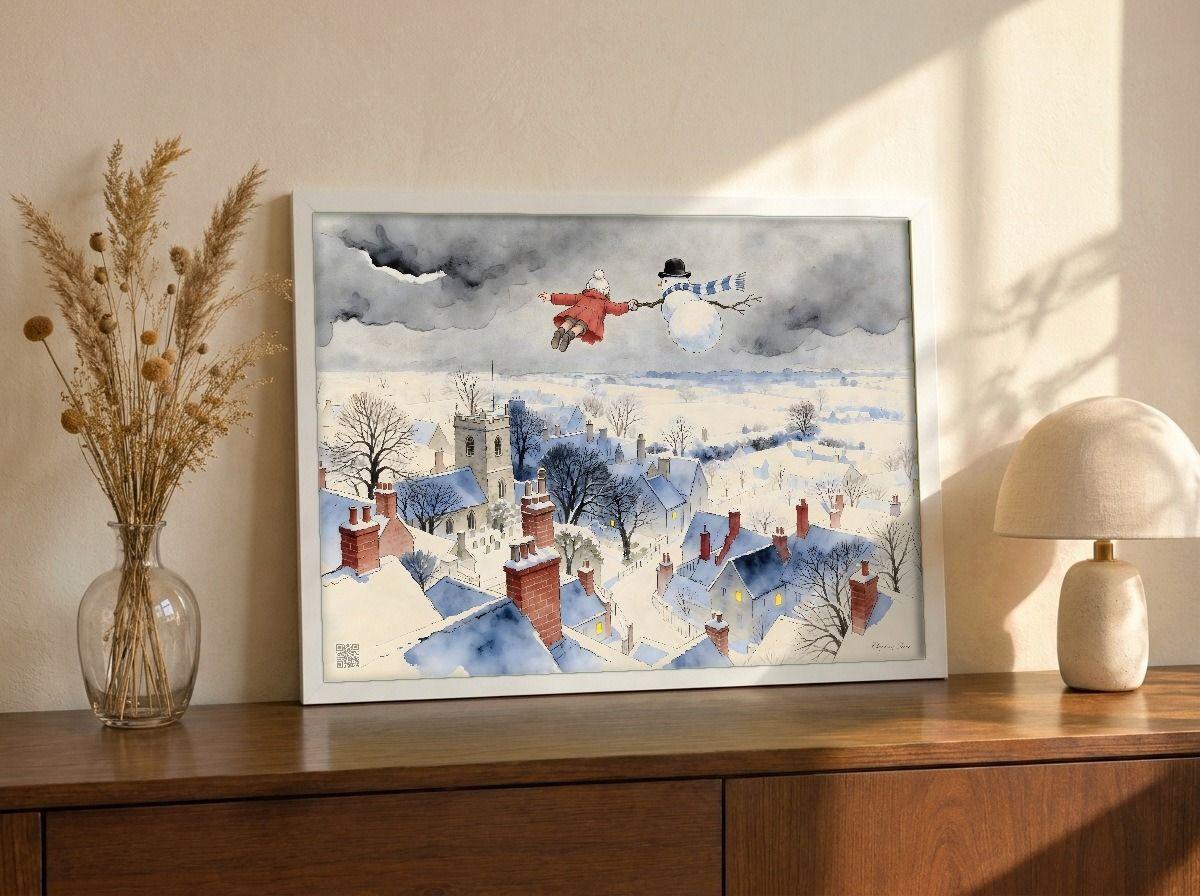
Browse our fantasy prints, or Christmas gifts for mum.
Questions
Questions, answered
Who wrote The Nutcracker?
E. T. A. Hoffmann wrote the original tale in 1816. Alexandre Dumas retold it in 1844, and Tchaikovsky composed the ballet that opened in 1892.
Is the Nutcracker story about Christmas?
Yes. It begins on Christmas Eve, when Marie is given the Nutcracker as a present, and the magic happens that night.
More from the journal
Keep reading
More guides and links
- Winnie-the-Pooh gifts for adults who still love Pooh
- Where to buy second hand books online in the UK
- Children's Classics prints
- Quiz: which book character are you?
- Christmas gifts for book lovers
- More christmas posts
- Christmas gifts for him
- Christmas gifts for her
- Christmas gifts for mum
- Christmas gifts for dad
- More from the journal