The Silmarillion explained: what it is, how it is built and where to start
Part of the Lord of the Rings fan hub: prints, bookmarks, gifts and guides in one place.
What is The Silmarillion?
It is the older story behind The Hobbit and The Lord of the Rings. Where those two books follow a few travellers, The Silmarillion tells the history of the whole world: how it was made, who shaped it, and the wars fought over three jewels called the Silmarils.
Tolkien began on these stories in 1914 and never finished them. In 1937 the publisher Allen & Unwin turned down a version as obscure and "too Celtic", so he wrote The Lord of the Rings instead and came back to the older material in the late 1950s. He died without a finished book. The one on the shelf was put together afterwards.
How is the book built?
The published book is five parts, in story order. The table gives each one in a line.
| Part | What it is |
|---|---|
| Ainulindalë | The creation story. Ilúvatar's Ainur sing a great music, Melkor brings discord into it, and the world is made. |
| Valaquenta | A catalogue of the Valar and Maiar, the powers who shape the world, with Melkor (later called Morgoth) among them. |
| Quenta Silmarillion | The main narrative, 24 chapters, covering the First Age and the wars over the Silmarils. It is most of the book. |
| Akallabêth | About 30 pages on the rise and fall of the island kingdom of Númenor in the Second Age. |
| Of the Rings of Power and the Third Age | About 20 pages covering the Second and Third Ages. It ends with a summary of The Lord of the Rings. |
Who edited it, and when was it published?
Christopher Tolkien selected the material, edited it and in places wrote it, and he was credited as editor. He also drew the maps. The first edition was a hardback from the publisher George Allen & Unwin, on 15 September 1977. HarperCollins brought out a paperback in 1999.
He had help. Guy Gavriel Kay, then a philosophy student at the University of Manitoba, moved to Oxford in 1974 to assist with the editing, chosen because of a family connection. He went back to Canada in 1975 to study law and later became a fantasy author.
The text is a construction, because Tolkien's drafts do not always agree. Christopher had to fill gaps, and the chapter Of the Ruin of Doriath was built almost from scratch. In 1983 he wrote that publishing the book without a frame story was "an error", and the twelve volumes of The History of Middle-earth (1983 to 1996) later printed most of the source texts. Some critics argue the single volume is largely his invention, and others say he should be counted as a writer in his own right. That is worth knowing, and it does not stop the book being read as Tolkien's world.
What is the story, in plain terms?
The Quenta Silmarillion is the heart of it. In outline: the Elves wake, and the craftsman Fëanor makes three jewels, the Silmarils. Melkor, with Ungoliant, destroys the Two Trees and steals them. Fëanor swears an oath of vengeance and the Noldor follow Melkor out of Valinor to Middle-earth. Hidden kingdoms are founded, wars are fought, and the great tales happen inside them. In the end the Valar defeat Melkor, most of Beleriand sinks, and the First Age closes.
| Tale | Chapter | In a sentence | Its own book |
|---|---|---|---|
| The Silmarils and the oath of Fëanor | 7 and 9 | Fëanor makes the jewels, loses them, and leads the Noldor out of Valinor in pursuit. | No |
| Beren and Lúthien | 19 | A mortal man and an Elf princess try to take a Silmaril from Morgoth's crown. Lúthien gives up her immortality to share his fate. | Beren and Lúthien (2017) |
| Túrin Turambar | 21 | Morgoth curses Húrin's family, and Túrin's life, with the dragon Glaurung in it, ends in tragedy. | The Children of Húrin (2007) |
| The Fall of Gondolin | 23 | The hidden city founded by King Turgon is betrayed and destroyed. Tuor leads survivors out, and Eärendil is born. | The Fall of Gondolin (2018) |
| Eärendil's voyage | 24 | Eärendil sails to Aman with a Silmaril to ask the Valar for help. The Valar then defeat Morgoth. | No |
The Akallabêth then tells how the Man-kingdom of Númenor falls. Sauron manipulates its king into attacking Aman, and Ilúvatar drowns the island. Elendil's survivors found Arnor and Gondor. The final section carries on to the forging of the One Ring, the defeat of Sauron by the Last Alliance, and the events of The Lord of the Rings.
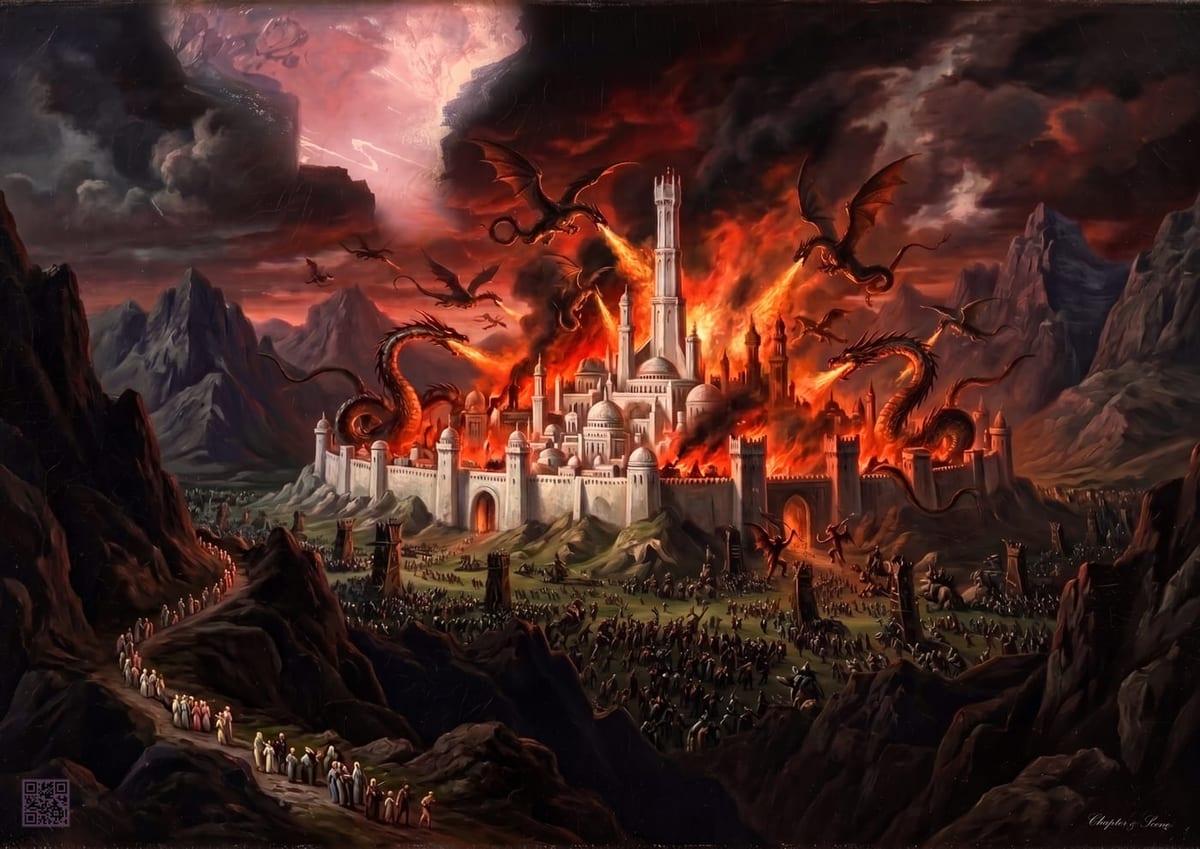
The tale of Beren and Lúthien mattered to Tolkien personally. After his wife Edith died, he had the name Lúthien put on her gravestone, and later Beren on his own. Our Fall of Gondolin print is in the style of the painter John Martin and is inspired by the book. It is not official merchandise.
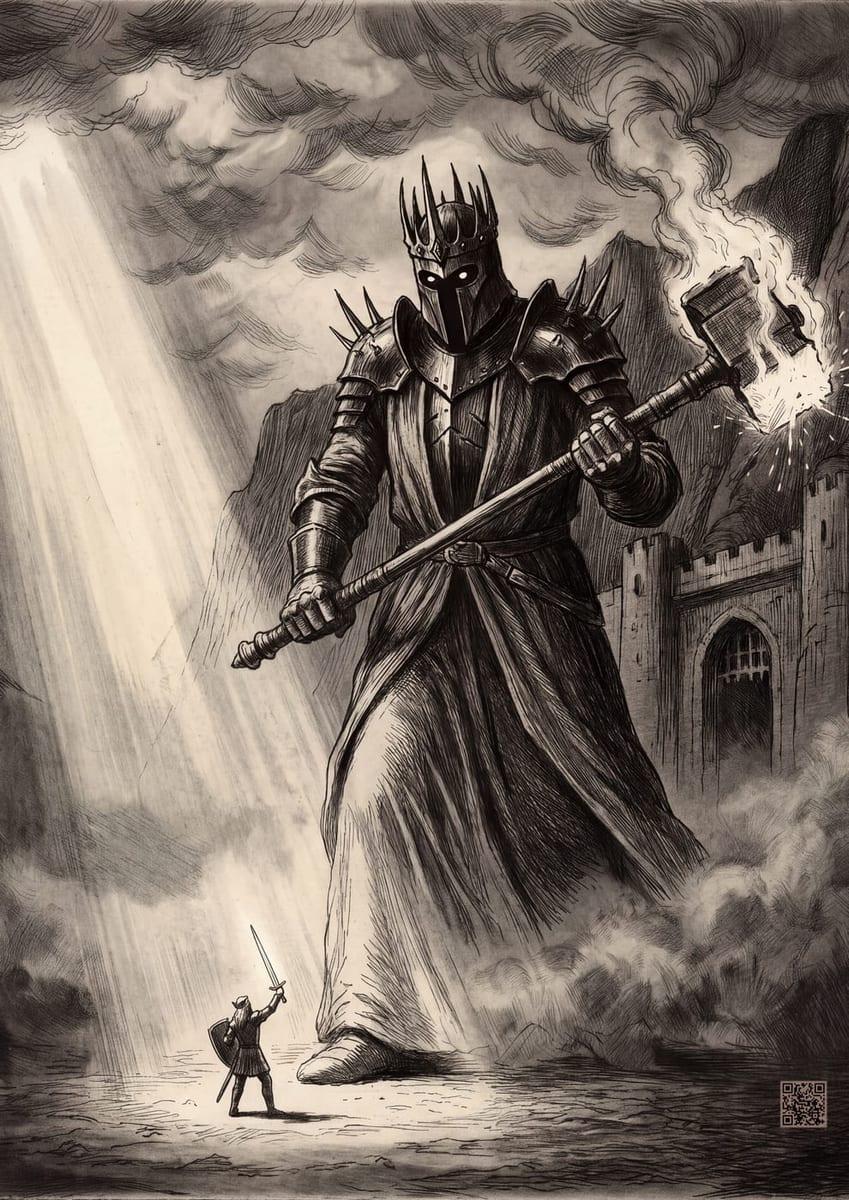
Not every great tale in the book is a love story. In the chapter on the fall of Fingolfin, the High King of the Noldor hears a false report that his allies have been routed and rides alone to the gates of Angband. He calls Morgoth out to single combat and wounds him seven times, but Morgoth cannot be killed. Fingolfin stumbles and is pinned and killed, but his last blow leaves Morgoth with a limp for good. The eagle Thorondor carries his body to a cliff above Gondolin, where his son Turgon raises a cairn over it, so his story links to the fall of Gondolin too. Our Fingolfin print shows the moment at the gates, in the style of a Rembrandt drypoint. It is an independent print inspired by the book, not official merchandise.
How does it connect to The Hobbit and The Lord of the Rings?
More than you might expect, and you can spot the links on a second read of the novels.
Sauron, the Dark Lord of The Lord of the Rings, is a lieutenant of Morgoth in the First Age, and in the Second Age he forges the One Ring. Elrond, a major figure in the War of the Ring, is the son of Eärendil, and Bilbo sings the Song of Eärendil at Rivendell. Galadriel, in The Silmarillion's account, took part in the flight of the Noldor from Valinor. Tolkien later rewrote her as someone who had not joined the rebellion, though that revision was never completed, so the sources disagree. Even the swords Glamdring and Orcrist, found in the trolls' hoard in The Hobbit, were forged in Gondolin.
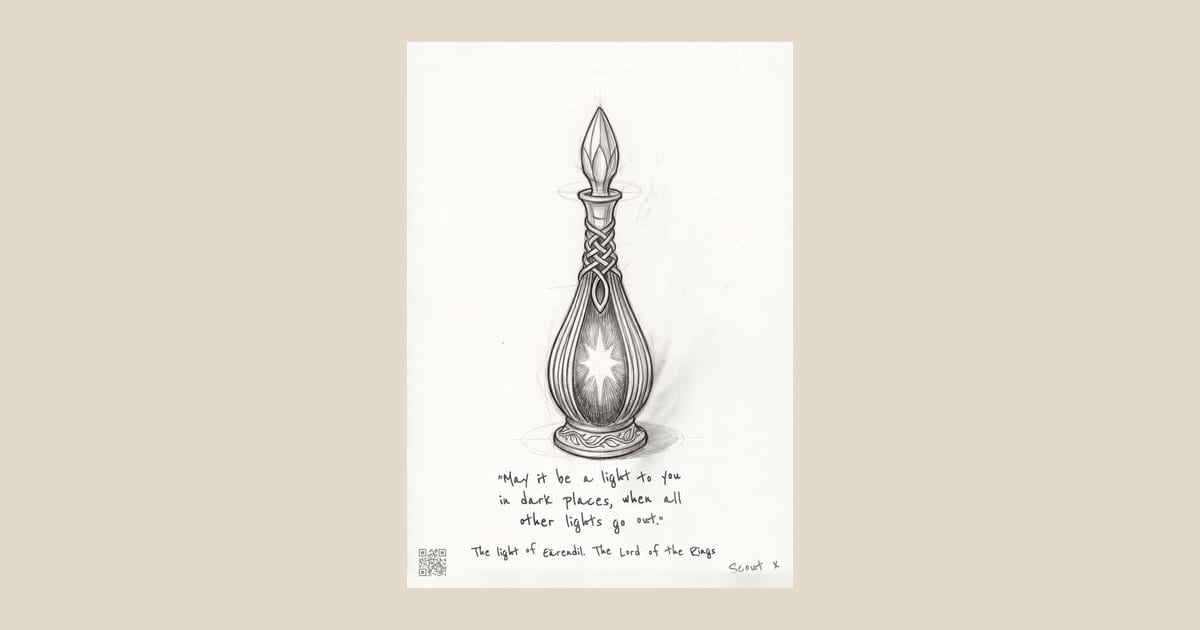
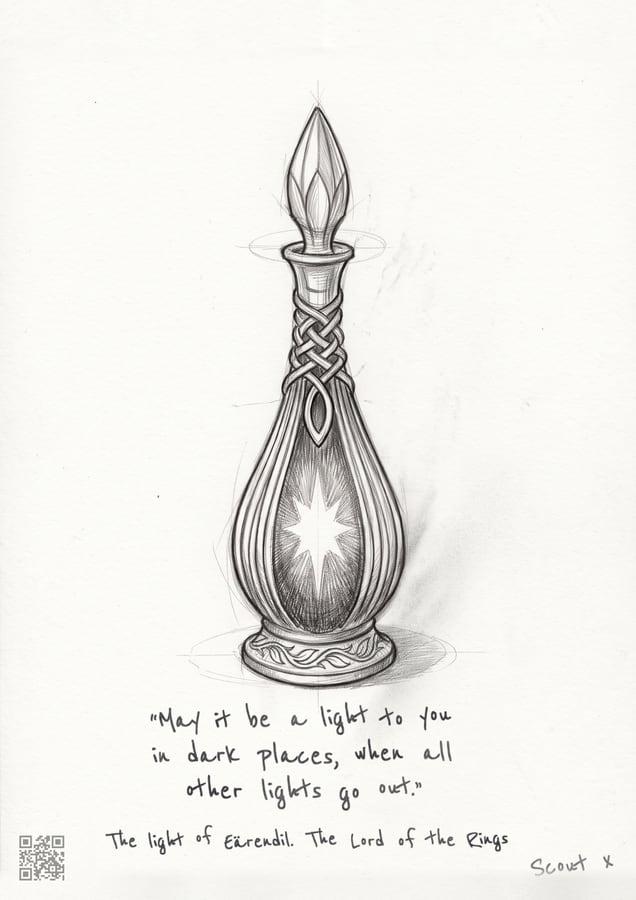
The Phial of Galadriel is the clearest link. It holds a little of the light of Eärendil's star, and Frodo calls on Eärendil by name when he uses it against Shelob. In The Silmarillion Eärendil carries a Silmaril across the sky as the Morning Star. Our Light of Earendil print is a pencil study of that phial, inspired by The Fellowship of the Ring. It is not official merchandise.
For who is who across all the books, see Lord of the Rings characters: who's who in Middle-earth, and for the places, the Lord of the Rings map explained.
Is The Rings of Power based on The Silmarillion?
No. It is set in the Second Age, mainly based on the appendices of The Lord of the Rings, with Tolkien's letters used for context, according to Wikipedia. The showrunners Patrick McKay and J. D. Payne said in a Vanity Fair interview in February 2022, as quoted by GeekTyrant, that they have the rights to the three Lord of the Rings volumes, the appendices and The Hobbit, and not to The Silmarillion.
That matters because the Second Age is told in The Silmarillion too, mostly in the Akallabêth and Of the Rings of Power. The series and the book share an age, not a script. For the series itself see our Rings of Power season 3 guide.
Is The Silmarillion hard to read?
Many readers say yes, and so did the first reviewers. Reviews in 1977 were generally negative. Critics pointed to its seriousness, the lack of a single quest, the archaic language and the number of names. Time magazine called it "majestic", and it won the Locus Award for Best Fantasy Novel in 1978, according to Wikipedia.
The reasons are plain enough. The style mixes chronicle and legend, there are no hobbits to guide you, and the cast is large and spread over thousands of years. The Tolkien Road guide describes the central thread as the struggle of the Valar, Elves and Men against Morgoth and his servants.
Where should I start?
These are our suggestions, not rules, and there is no wrong way in.
- Read the novels first, in publication order. Our guide to the Lord of the Rings books in order explains why. The Tolkien Road guide gives the same advice.
- Then read the Quenta Silmarillion in order, a chapter at a time. Treat the Ainulindalë as a short prelude, and skim the Valaquenta, which is a catalogue more than a story.
- Keep a map beside you. The guide notes that the book's map of Beleriand only becomes useful from around chapter 10.
- Or go in by a single tale. Beren and Lúthien (2017), The Children of Húrin (2007) and The Fall of Gondolin (2018) are each a standalone book, edited by Christopher Tolkien and illustrated by Alan Lee. Beren and Lúthien begins with The Tale of Tinúviel from The Book of Lost Tales and gathers versions of the story into one largely continuous telling.
- Do not mind spoilers. The book's pleasure is in its detail more than its twists, so reading a plot summary first does it no harm.
Which edition should I buy?
We will not call one edition the best, because no source we read does. There are three kinds. The standard text has been in print since the 1977 hardback, with the HarperCollins paperback of 1999. Illustrated editions use paintings by the artist Ted Nasmith, and HarperCollins's own rights page lists one as a trade paperback with 20 illustrations. The standalone tales above come with Alan Lee's artwork.
Be careful with illustrated editions. Wikipedia gives different years for the Nasmith editions in different places, naming 1998, 2004 and 2008, so check the edition details on the listing before you buy. The books mentioned in this guide are below.
The books in this guide: buy at Amazon: The Silmarillion · The Hobbit · The Fellowship of the Ring
More from this guide to Tolkien's world
- Up: the Lord of the Rings hub, with a timeline of Middle-earth and the stories behind each scene.
- Next: The Lord of the Rings books in order.
- Next: What the One Ring inscription says.
- Next: Rings of Power season 3: dates, cast, trailer, story.
Sources (16)
All read on 22 November 2026 and written up here in our own words.
- Wikipedia, The Silmarillion, for the parts, the 1977 publication, editions, reception, origins and Christopher Tolkien's later comment.
- Wikipedia, Quenta Silmarillion, for the order of events and the chapter Christopher built from scratch.
- Wikipedia, Christopher Tolkien, for his editing, The History of Middle-earth and the debate over his role.
- Wikipedia, Guy Gavriel Kay, for his move to Oxford in 1974 and return in 1975.
- The Tolkien Road, A (Mega)Guide to The Silmarillion, for chapter titles, why the book is hard and reading advice.
- Wikipedia, Beren and Lúthien, for the 2017 book and the gravestone names.
- Wikipedia, The Children of Húrin, for the 2007 book and Túrin's story.
- Wikipedia, The Fall of Gondolin, for the 2018 book and the city's story.
- Wikipedia, Eärendil, for the voyage, Elrond, the Phial and Bilbo's song.
- Wikipedia, Galadriel, for her part in the flight of the Noldor and Tolkien's later rewrite.
- Wikipedia, Sauron, for his place in the First and Second Ages.
- Wikipedia, Glamdring, for swords forged in Gondolin.
- Wikipedia, The Lord of the Rings: The Rings of Power, for the series' source material and rights.
- GeekTyrant, the showrunners on the rights, quoting the Vanity Fair interview of February 2022.
- HarperCollins Rights, The Silmarillion: Illustrated edition, for the Ted Nasmith edition.
- Wikipedia, Fingolfin, for his single combat with Morgoth, the limp and the cairn above Gondolin.
As an Amazon Associate, Chapter & Scene earns from qualifying purchases.
Worth following
More Tolkien, from places we like. Pick a tab, then swipe.
Where fans and scholars go to read
 The Tolkien SocietyCharity and fan clubEvents, publications and Tolkien Reading DayOpen the Tolkien Society
 Tolkien GatewayEncyclopediaAn article for nearly every character, place and eventOpen Tolkien Gateway
 TheOneRing.netNews and fan communityTolkien news since 1999Open TheOneRing.net
 The Tolkien EstateOfficial siteThe author's official siteOpen the Tolkien Estate
Each opens in a new tab. Independent of Chapter & Scene.
For the commute, the walk or the washing up
 The Prancing Pony PodcastPodcastA weekly show from two fansOpen The Prancing Pony Podcast
 The Tolkien ProfessorPodcast and lecturesCorey Olsen, close readingOpen The Tolkien Professor
 The Nerd of the RingsPodcastNews and interviewsOpen it on Apple Podcasts
 Mythgard InstitutePodcast seriesExploring The Lord of the RingsOpen the Mythgard Institute
Each opens in a new tab. Independent of Chapter & Scene.
Lore, maps and book breakdowns
Each opens in a new tab. Independent of Chapter & Scene.
The Middle-earth Strategy Battle Game
Each opens in a new tab. Independent of Chapter & Scene.
Four ways to hear it
 The Lord of the Rings, read by Andy SerkisAudiobookUnabridged, three parts (2021)Find it on Audible UK
 The Hobbit, read by Andy SerkisAudiobookHarperCollins studio recording (2020)Open it on Apple Books The Lord of the Rings, read by Rob InglisAudiobookUnabridged, a long-loved readingOpen the series on Audible UK The Lord of the Rings, BBC Radio dramatisationFull-cast audio dramaThe 1981 BBC Radio 4 seriesFind it on Audible UK
Each opens in a new tab. Independent of Chapter & Scene.
Questions
What is The Silmarillion about?
It is the history of Tolkien's world from its creation, through the wars over the three Silmarils in the First Age, to the forging of the One Ring and the end of the Third Age. Its best known tales are Beren and Lúthien, Túrin, the fall of Gondolin and Eärendil's voyage.
Who edited it, and when was it published?
Christopher Tolkien edited it, with help from Guy Gavriel Kay, and George Allen & Unwin published it on 15 September 1977. J. R. R. Tolkien had died in 1973.
Is The Silmarillion hard to read?
Many readers find it so. It has a large cast across thousands of years, no single quest and a formal style, and early reviews in 1977 were generally negative.
Where should I start?
Read The Hobbit and The Lord of the Rings first, then read the Quenta Silmarillion in order, or go in by one of the standalone tales: Beren and Lúthien, The Children of Húrin or The Fall of Gondolin.
How does it connect to The Lord of the Rings?
It tells the earlier history behind it. Sauron, Elrond, Galadriel and the light in the Phial of Galadriel all link back to its tales, and its last section ends with a summary of The Lord of the Rings.
Is The Rings of Power based on The Silmarillion?
No. The showrunners said they have the rights to The Lord of the Rings, its appendices and The Hobbit, and not to The Silmarillion. The series shares the Second Age with the book without adapting it.