The Wind in the Willows: the book, its chapters and its characters
Part of the Children's classics fan hub: prints, bookmarks, gifts and guides in one place.
Who wrote The Wind in the Willows, and when?
Kenneth Grahame was born in Edinburgh on 8 March 1859 and spent most of his working life at the Bank of England. He joined as a clerk on 1 January 1879, became its Secretary in 1898 and retired in 1908, aged 49. The Wind in the Willows came out in the same year, on 8 October 1908, from Methuen in the UK and Scribner in the US.
Grahame died at Pangbourne on 6 July 1932. He had written other books before this one, and critics at the time wanted another in the style of those. Early reviews were mostly poor, but readers took to it at once, and by 1951 it had reached 100 editions in Britain alone.
How did the book begin?
Grahame married Elspeth Thomson in 1899, and their son Alastair, nicknamed Mouse, was born in 1900. When the boy was around four, his father told him bedtime stories, some of them about a toad. On boating holidays without his family, Grahame wrote more tales of Toad, Mole, Ratty and Badger in letters to his son.
After he left the Bank, he turned those stories into a manuscript at an old farmhouse in Blewbury, Berkshire. Wikipedia's two pages disagree on when the family moved there, 1908 on one and 1910 on the other. More on where the stories came from is in The Wind in the Willows and the Thames.
What is The Wind in the Willows about?
In spring, Mole leaves his underground home and meets Water Rat on the river. They become close friends. Toad, the rich and impulsive owner of Toad Hall, takes up one craze after another, from boating to caravans, and settles on motorcars. That leads to crashes, fines and, in the end, prison.
Between the Toad chapters sit quieter episodes with Rat and Mole, and many adaptations leave them out. In winter, Mole is lost in the Wild Wood, Rat finds him and the two shelter with Badger. The friends try to keep Toad out of trouble, he escapes in disguise, and he comes home to find his house taken over. With help, he gets it back, and he is a changed animal by the end.
Who are the characters?
| Character | Who they are |
|---|---|
| Mole | Shy, kind and fond of home. He is the first character we meet, and learns river life with Rat's help. |
| Ratty (Water Rat) | A water vole: charming, loyal and a dreamer who writes little rhymes. He risks his life to save Mole. |
| Badger | A gruff but kind hermit who lives in tunnels that take in an old Roman settlement. He was a friend of Toad's late father. |
| Mr Toad | Rich, sociable and impulsive. He drops each craze quickly, until he finds motorcars. |
| Otter and Portly | Otter is Ratty's confident friend, with a street-trader's way of talking. Portly is his young son. |
| Pan | A gentle wild god who appears in one chapter only, the seventh, where he looks after the lost Portly. |
| Weasels, stoats and ferrets | The villains who take over Toad Hall. Their leader is known as the Chief Weasel. |
| The Wild Wooders | Weasels, stoats and foxes of the Wild Wood, whom Rat does not trust. |
| The gaoler's daughter | The only major human character. She helps Toad to escape from prison. |
| The barge-woman and the engine driver | Two humans on Toad's flight home. One throws him in the river when she sees what he is, the other gives him a lift. |
What are the chapters, and which are the famous ones?
The twelve chapters, in order, are these.
- The River Bank
- The Open Road
- The Wild Wood
- Mr. Badger
- Dulce Domum
- Mr. Toad
- The Piper at the Gates of Dawn
- Toad's Adventures
- Wayfarers All
- The Further Adventures of Toad
- Like Summer Tempests Came His Tears
- The Return of Ulysses
The most quoted are probably the seventh and the ninth. In The Piper at the Gates of Dawn, Rat and Mole go looking for Otter's lost son Portly and find Pan, who has been caring for him. It is the one moment of wonder in the book, and Pink Floyd's first album, in 1967, took its name from it.
In Wayfarers All, a seafaring rat turns up and Rat is briefly tempted to leave with him, until Mole talks him out of it. Toad's prison escape, by contrast, takes two chapters, the eighth and the tenth, and the Toad chapters as a whole make up about half the book.
What happens at Toad Hall?
Toad Hall is Toad's home, a handsome, dignified house of old red brick with lawns that run down to the water. In the book there is also a hidden underground passage from the riverbank into the hall.
While Toad is in prison, weasels, stoats and ferrets move in. When he gets home, his friends help him take the house back, and the story ends with Toad reformed.
Where is the real river?
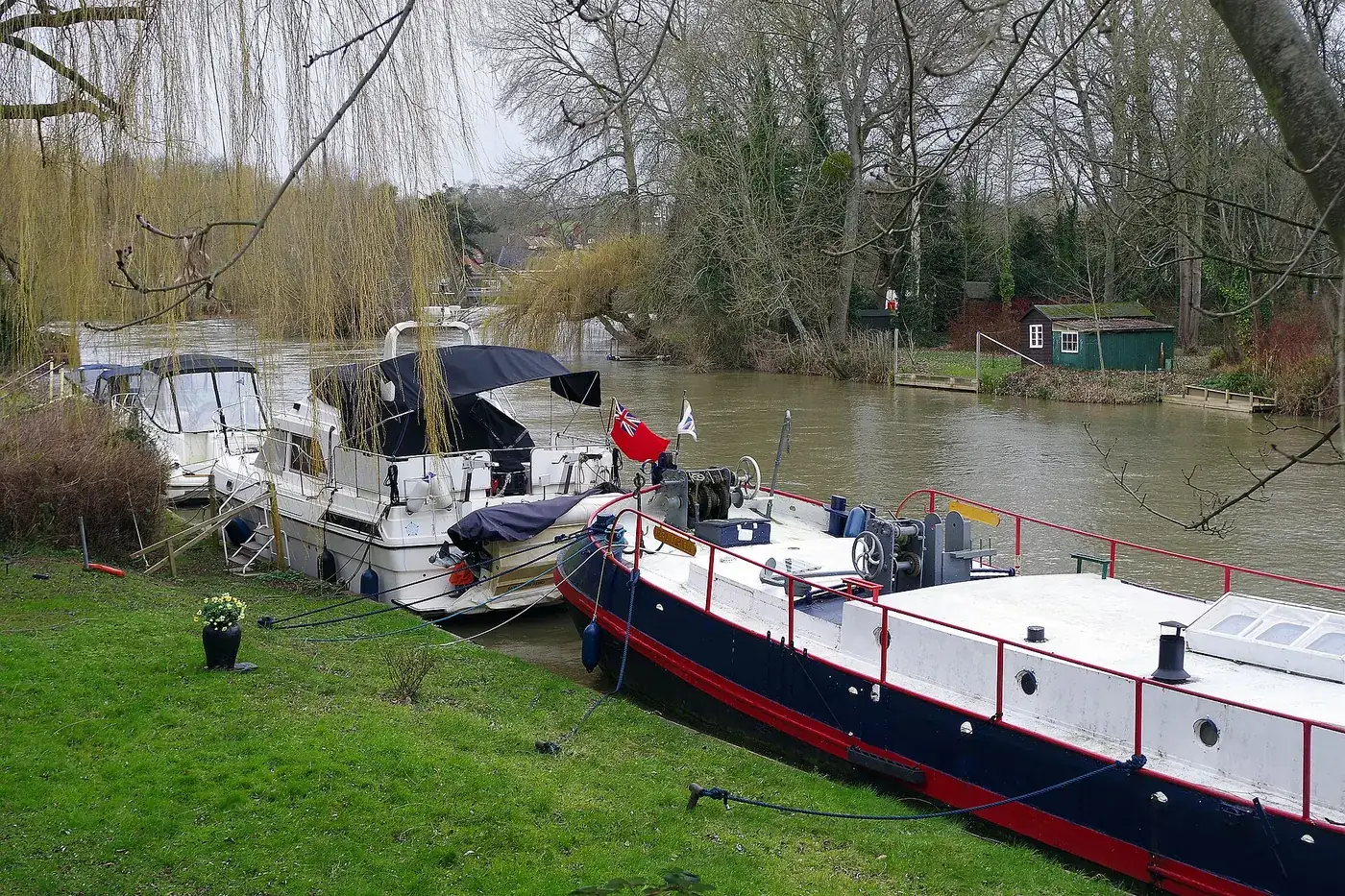
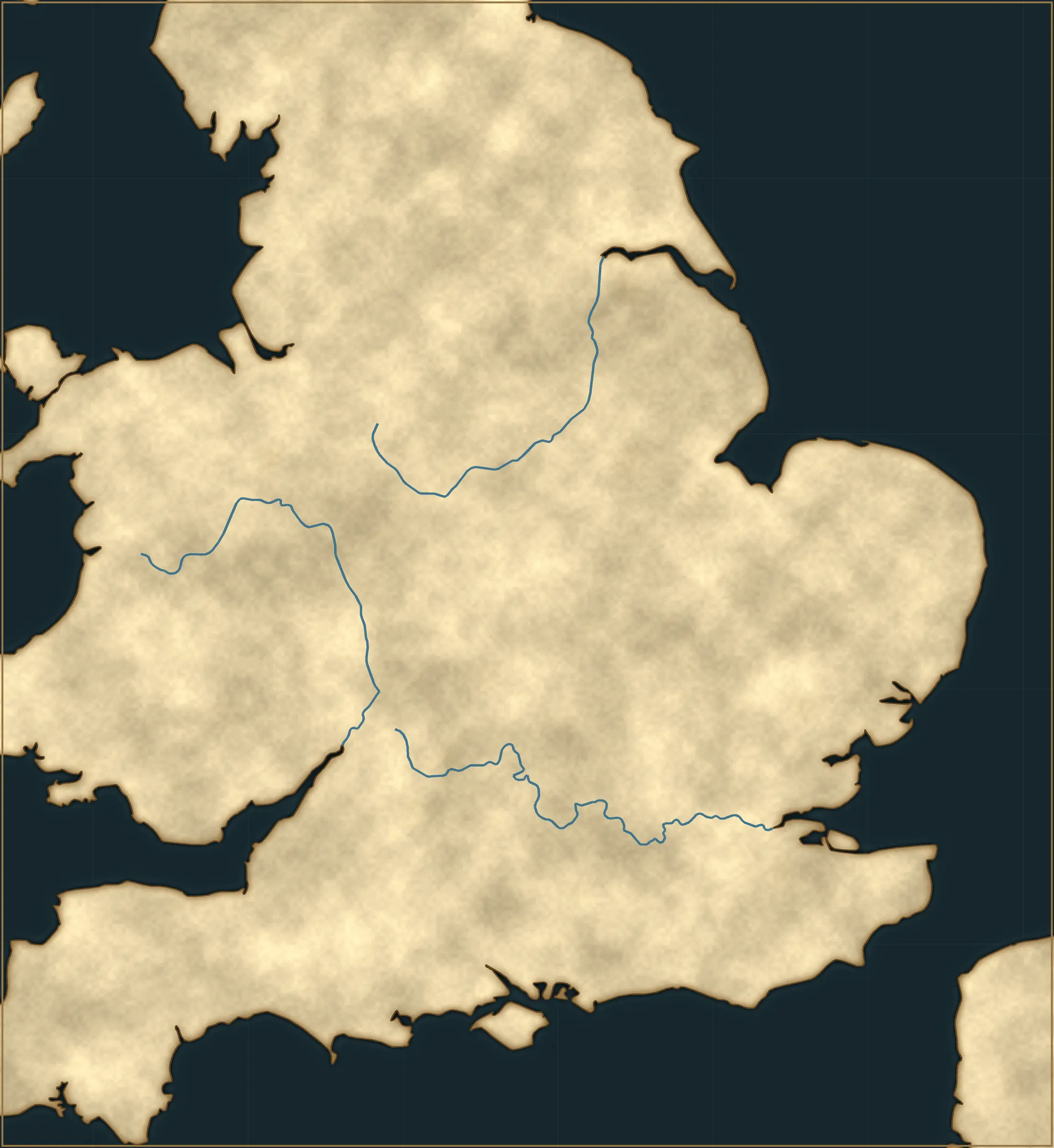
Grahame knew the Thames from childhood. After his mother died in 1864, the children went to live with their grandmother at The Mount in Cookham Dean, Berkshire, a house with terraced gardens by the river. Their uncle took them boating nearby at Bisham. In 1906 Grahame leased a house called Mayfield in Cookham Dean, close to where he grew up.
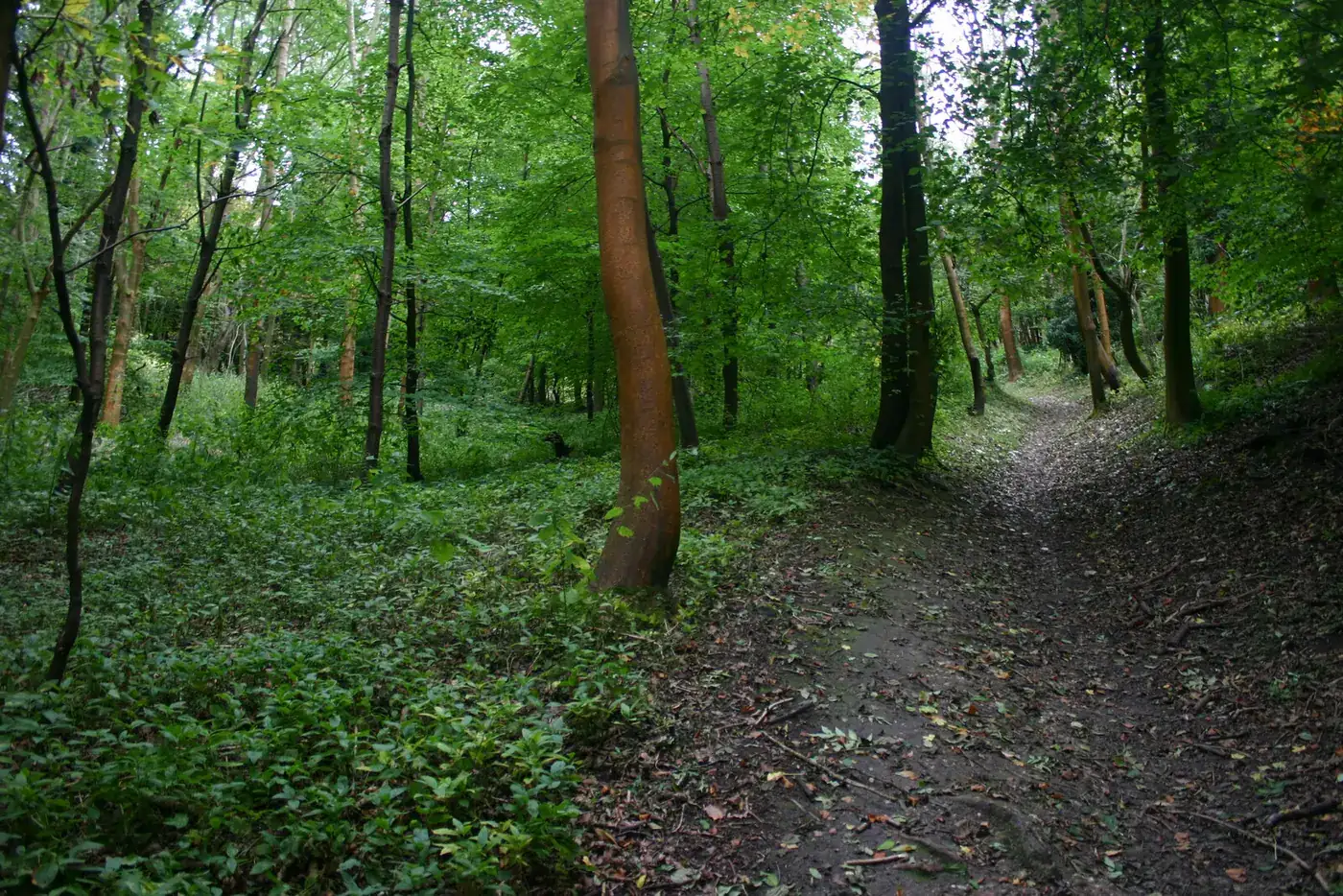
The Wild Wood is usually placed near there. Peter Ackroyd names Quarry Wood at Cookham Dean as the original, Countryfile calls it the likely model, and a tourism page for the area gives Bisham Wood instead. As for Pangbourne, Grahame lived his last years there, at Church Cottage, and died there. We found no source that says it is the setting, so we do not claim that.
The Thames is not the whole answer either. Countryfile says the book also draws on the Crinan Canal in Scotland, where he first saw water voles, on the Cherwell at Oxford and on the River Fowey in Cornwall. For Toad Hall, Mapledurham House, Hardwick House, Fawley Court, Fowey Hall Hotel, Foxwarren Park and Cliveden have all been put forward. Nobody can say for sure, so treat each as a guess.
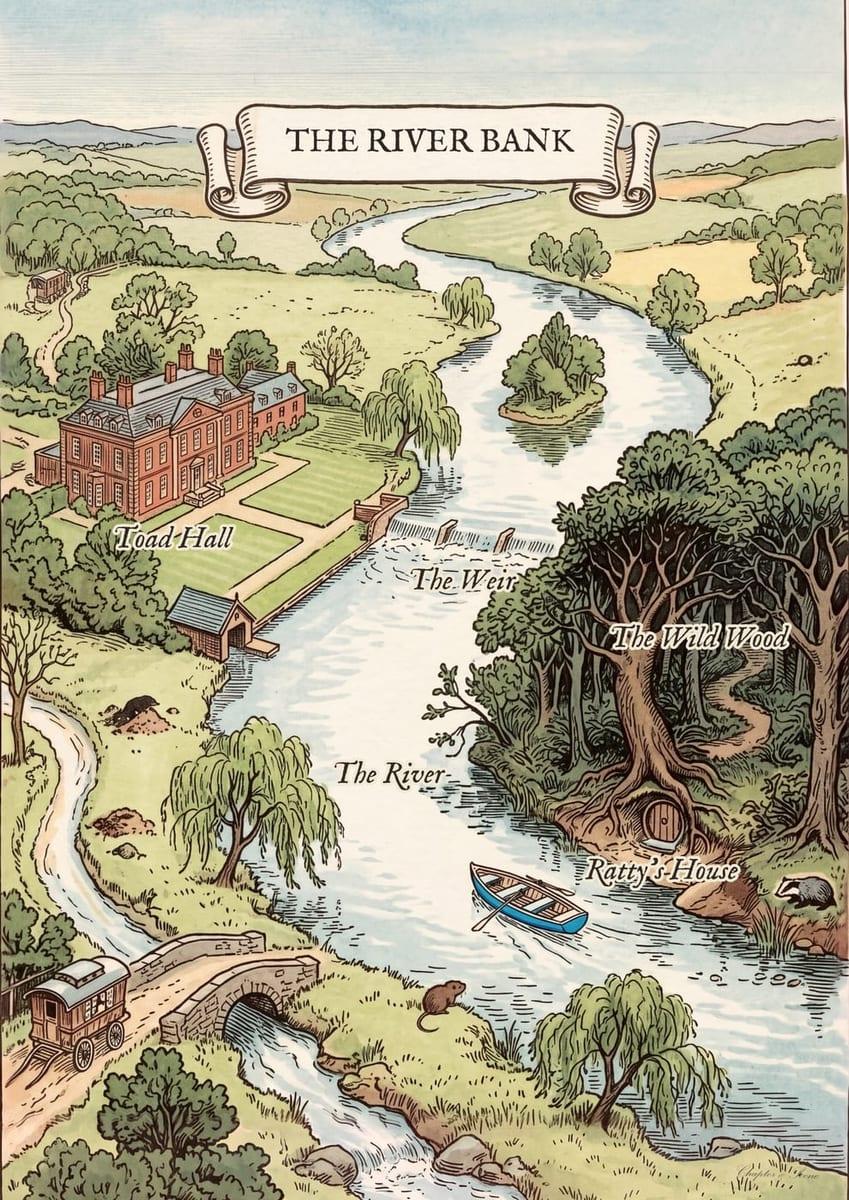
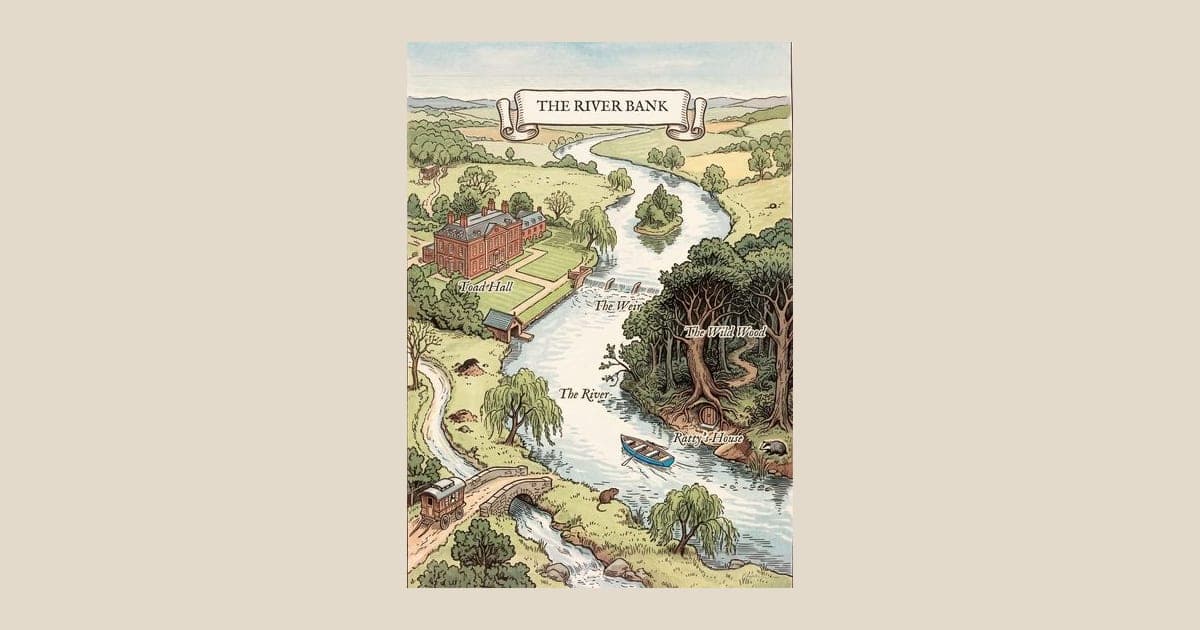
Our River Bank print is our own design inspired by the book: a storybook map from Ratty's house to Toad Hall, with the Wild Wood on one bank. It is an independent print, not official merchandise.
Who illustrated it?
The first edition carried a frontispiece and cover by W. Graham Robertson, and the book has been illustrated many times since. E. H. Shepard's pictures of 1931 are probably the best known and are believed to have been authorised. Countryfile reports that Grahame met Shepard in 1930 and told him, 'I love these little people; be kind to them.'
| Illustrator | Edition | Note |
|---|---|---|
| W. Graham Robertson | 1908 | Frontispiece of the first edition. |
| Paul Bransom | 1913 | An early illustrated edition. |
| Wyndham Payne | 1927 | Known for a canary-yellow cover. |
| E. H. Shepard | 1931 | Probably the most popular pictures. He made a colour version in 1969. |
| Arthur Rackham | 1940 (US), 1950 (UK) | Sixteen colour plates, his last work, published after his death on 6 September 1939. |
| Michael Hague | 1980 | A later illustrated edition. |
| Robert Ingpen | 2007 | A modern illustrated edition. |
Rackham's career is covered in our guide to Arthur Rackham and the golden age of illustration.
Is The Wind in the Willows in the public domain in the UK?
The text is. GOV.UK says copyright in a written work generally lasts 70 years after the author's death, and the Copyright, Designs and Patents Act counts that from the end of the calendar year of death. Grahame died in 1932, so the term for his words ended at the close of 2002.
The pictures can be a different matter, because each artist has their own term. Shepard died on 24 March 1976, which by the same rule runs to the end of 2046. Rackham died in 1939, which puts his term well in the past. Free editions of the text are available from Standard Ebooks. Shepard also drew Winnie-the-Pooh, and our post on Winnie-the-Pooh gifts for adults has ideas for the same kind of reader.
Has it been adapted?
Many times. A short list of ones we could check is below.
| Year | Adaptation |
|---|---|
| 1929 | Toad of Toad Hall, A. A. Milne's play, first staged on 21 December at the Playhouse Theatre in Liverpool. Milne built it around the Toad story. |
| 1949 | Disney's The Adventures of Ichabod and Mr. Toad. |
| 1983 | A stop-motion film by Cosgrove Hall, with David Jason. |
| 1996 | Terry Jones's live-action film, with Steve Coogan and Eric Idle. |
| 2026 | A new stage adaptation at the Rose Theatre, Kingston, by Rob Evans, from 25 November 2026 to 3 January 2027. |
Why does it still sell, and who should you give it to?
It has lasted. In 1909 President Theodore Roosevelt wrote to Grahame to say he had read it again and again and thought of the characters as old friends. In the BBC's Big Read, it came 16th, and Book magazine put Toad at 38 in a list of the 100 best fictional characters since 1900.
As for who to give it to, the language and pace suit reading aloud, so it works for a child who likes animal stories and for a grown-up who read it at school and wants it back. Pick the illustrator for the person: Shepard for the best-known look, Rackham for his colour plates.
The Wind in the Willows: The Wind in the Willows
Sources (12)
All read on 22 November 2026 and written up here in our own words.
- Wikipedia: The Wind in the Willows, for the publication, plot, characters, reception, illustrators and adaptations.
- Wikisource: The Wind in the Willows (1913), for the twelve chapter titles.
- Wikipedia: Kenneth Grahame, for his life, Cookham Dean, Pangbourne and his son.
- Wikipedia: Cookham Dean, for Mayfield and The Mount.
- Countryfile: Wild People, Kenneth Grahame, for Shepard's visit and the places behind the book.
- Visit South East England: Kenneth Grahame, for Bisham Wood.
- Wikipedia: Toad Hall, for the house in the book and the houses suggested for it.
- Wikipedia: Toad of Toad Hall, for Milne's 1929 play.
- Wikipedia: E. H. Shepard and Wikipedia: Arthur Rackham, for the two illustrators and their dates.
- GOV.UK: how long copyright lasts and Copyright, Designs and Patents Act 1988, section 12, for the term of copyright.
- Standard Ebooks, for a free edition of the text.
- Theatre Weekly, for the Rose Theatre dates.
As an Amazon Associate, Chapter & Scene earns from qualifying purchases.
Worth following
More children's classics, from places we like. Pick a tab, then swipe.
Where fans and scholars go to read more
 Narnia: The Magician's NephewOfficial film siteTrailer, screenings and ticketsOpen the official Narnia site
 The World of Peter RabbitOfficial siteNews and activities from Peter Rabbit's own homeOpen the Peter Rabbit site The Beatrix Potter SocietySocietyHer life and works, with membershipOpen the Beatrix Potter Society
 The Lewis Carroll SocietySocietyAlice, Jabberwocky and the SnarkOpen the Lewis Carroll Society
 L. M. Montgomery InstituteUniversity instituteThe author of Anne of Green GablesOpen the L. M. Montgomery Institute
Each opens in a new tab. Independent of Chapter & Scene.
The real houses and toys behind the books
 Hill Top, Near SawreyNational Trust houseBeatrix Potter's home in the Lake DistrictOpen the National Trust page Green Gables Heritage PlaceParks Canada siteAnne's home at Cavendish, Prince Edward IslandOpen the Parks Canada page
 The Winnie-the-Pooh toys, New York Public LibraryLibrary displayThe original Pooh, Eeyore, Piglet, Kanga and TiggerOpen the library page
Each opens in a new tab. Independent of Chapter & Scene.
Free to read and hear, ready when you are
 Alice's Adventures in Wonderland (Standard Ebooks)Free ebookThe Tenniel edition, free to downloadOpen Standard Ebooks
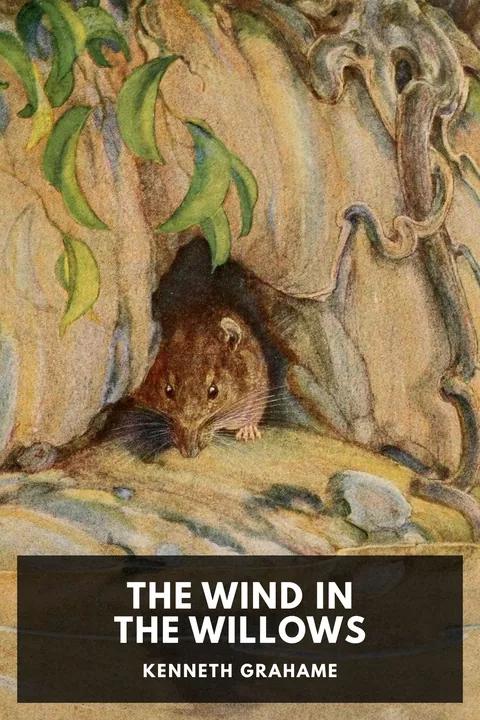 The Wind in the Willows (Standard Ebooks)Free ebookFour animals adventure through the English countrysideOpen Standard Ebooks
 Alice's Adventures in Wonderland (LibriVox)Free audiobookA volunteer recording, free to streamOpen LibriVox
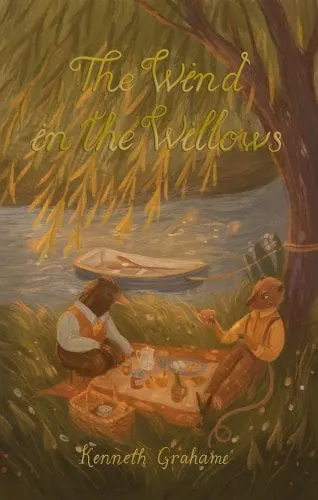 The Wind in the Willows (LibriVox)Free audiobookFree to stream, version 2Open LibriVox
 The Secret Garden (LibriVox)Free audiobookFrances Hodgson Burnett, free to streamOpen LibriVox
 The Wonderful Wizard of Oz (LibriVox)Free audiobookA dramatic reading, free to streamOpen LibriVox
 Anne of Green Gables (LibriVox)Free audiobookL. M. Montgomery, free to streamOpen LibriVox
Each opens in a new tab. Independent of Chapter & Scene.
Questions
Who wrote The Wind in the Willows, and when?
Kenneth Grahame wrote it, and Methuen first published it in the UK on 8 October 1908. Grahame died in 1932.
How did the book begin?
It grew from bedtime stories Grahame told his son Alastair, nicknamed Mouse, and from tales of Toad, Mole, Ratty and Badger he wrote to him in letters from boating holidays.
What is The Wind in the Willows about?
Mole meets Water Rat on the river, and the two friends, with Badger, try to keep Toad out of trouble as his craze for motorcars lands him in prison. Toad later returns to find weasels, stoats and ferrets in Toad Hall and has to win it back.
Who are the main characters?
Mole, Ratty (Water Rat, who is a water vole), Badger and Mr Toad. The supporting cast includes Otter, his son Portly, the god Pan, the gaoler's daughter and the Chief Weasel.
How many chapters are there, and which are the famous ones?
There are twelve chapters. The Piper at the Gates of Dawn (chapter 7) and Wayfarers All (chapter 9) are among the best known.
Is The Wind in the Willows in the public domain in the UK?
The text is, because UK copyright in a written work lasts 70 years after the author's death and Grahame died in 1932. Illustrators have their own terms, and Shepard's pictures, for one, are still protected.