The Raven by Edgar Allan Poe: the poem, line by line
Part of the Gothic and horror fan hub: prints, bookmarks, gifts and guides in one place.
When was The Raven published?
The Raven was first published in January 1845. It was first attributed to Poe in print in the New York Evening Mirror on 29 January 1845, and it made him popular in his lifetime, though it did not bring him much money. It was soon reprinted, parodied and illustrated (Wikipedia).
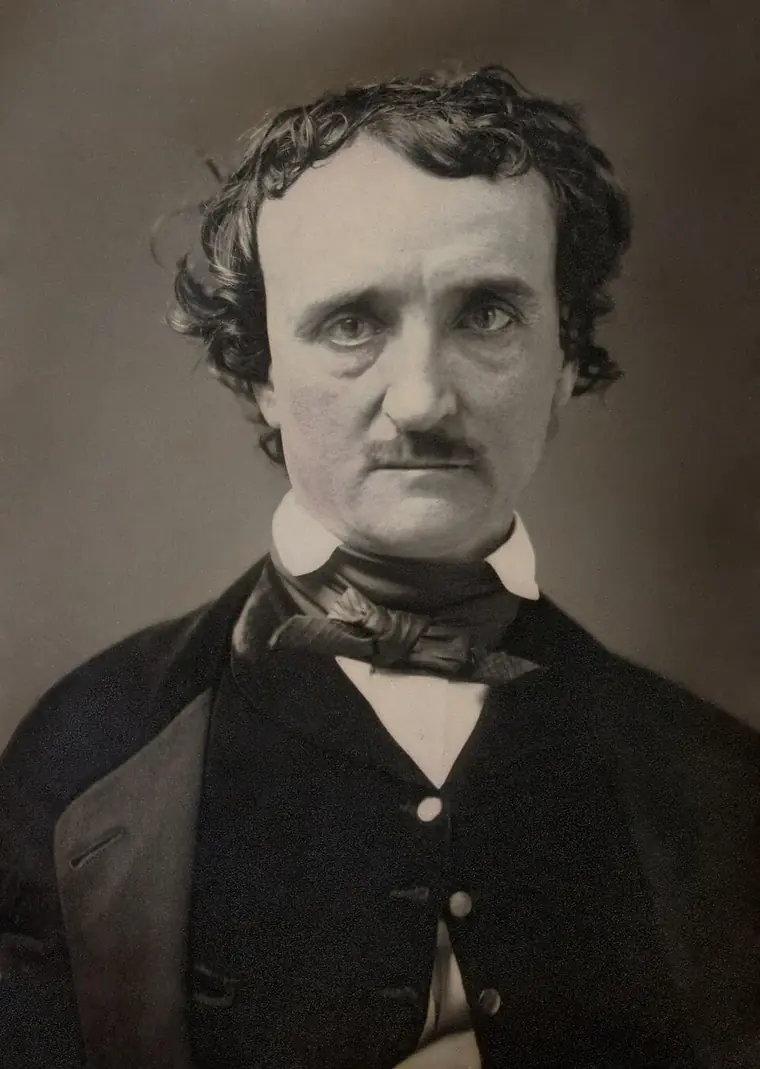
What inspired The Raven?
Wikipedia says the poem was inspired in part by a talking raven in Charles Dickens's 1841 novel Barnaby Rudge. Poe based its complex rhythm and meter on Elizabeth Barrett's poem Lady Geraldine's Courtship, and used internal rhyme and alliteration throughout. In his 1846 essay The Philosophy of Composition, Poe said he wrote the poem in a logical, methodical way.
What is The Raven about?
An unnamed narrator, often thought of as a student, is grieving his lost love Lenore on a dreary December night when a raven comes in and perches on a bust of Pallas above his door. The only word the bird ever says is Nevermore. The main theme is one of undying devotion: he wants both to forget and to remember.
The Raven, stanza by stanza
The text is the version in The Raven and Other Poems (1845), as transcribed on Wikisource. Dashes are shown as commas or spaces. It is in the public domain.
Stanza 1
ONCE upon a midnight dreary, while I pondered, weak and weary,Over many a quaint and curious volume of forgotten lore,While I nodded, nearly napping, suddenly there came a tapping,As of some one gently rapping, rapping at my chamber door."'Tis some visiter," I muttered, "tapping at my chamber door,Only this, and nothing more."
A midnight in a study. The narrator is half asleep over old books when a tapping begins. The first stanza sets the rhythm and the inner rhymes (dreary and weary, napping and tapping) that run through the whole poem.
Stanza 2
Ah, distinctly I remember it was in the bleak December,And each separate dying ember wrought its ghost upon the floor.Eagerly I wished the morrow; vainly I had sought to borrowFrom my books surcease of sorrow, sorrow for the lost Lenore,For the rare and radiant maiden whom the angels name Lenore,Nameless here for evermore.
It is December and the fire is dying. He had hoped his books would ease his sorrow for Lenore, a rare and radiant maiden whom the angels name Lenore.
Stanza 3
And the silken sad uncertain rustling of each purple curtainThrilled me, filled me with fantastic terrors never felt before;So that now, to still the beating of my heart, I stood repeating"'Tis some visiter entreating entrance at my chamber door,Some late visiter entreating entrance at my chamber door; This it is, and nothing more."
The rustle of the purple curtains fills him with terrors he has never felt, and to calm his heart he keeps repeating that it is only a late visitor.
Stanza 4
Presently my soul grew stronger; hesitating then no longer,"Sir," said I, "or Madam, truly your forgiveness I implore;But the fact is I was napping, and so gently you came rapping,And so faintly you came tapping, tapping at my chamber door,That I scarce was sure I heard you", here I opened wide the door; Darkness there, and nothing more.
His courage grows. He apologises to the visitor, says he was napping, and opens the door. There is only darkness.
Stanza 5
Deep into that darkness peering, long I stood there wondering, fearing,Doubting, dreaming dreams no mortal ever dared to dream before;But the silence was unbroken, and the darkness gave no token,And the only word there spoken was the whispered word, "Lenore!"This I whispered, and an echo murmured back the word, "Lenore!"Merely this, and nothing more.
He stares into the dark, wondering and fearing. The only word spoken is his own whisper, Lenore, and an echo gives it back.
Stanza 6
Back into the chamber turning, all my soul within me burning,Soon I heard again a tapping somewhat louder than before."Surely," said I, "surely that is something at my window lattice;Let me see, then, what thereat is, and this mystery explore,Let my heart be still a moment and this mystery explore; 'Tis the wind and nothing more!"
Back in his room he hears the tapping again, a little louder. He decides it must be at the window, and that it is only the wind.
Stanza 7
Open here I flung the shutter, when, with many a flirt and flutter,In there stepped a stately raven of the saintly days of yore;Not the least obeisance made he; not an instant stopped or stayed he;But, with mien of lord or lady, perched above my chamber door,Perched upon a bust of Pallas just above my chamber door,Perched, and sat, and nothing more.
He flings open the shutter and a stately raven walks in. It makes no bow, and perches on a bust of Pallas above his door.
Stanza 8
Then this ebony bird beguiling my sad fancy into smiling,By the grave and stern decorum of the countenance it wore,"Though thy crest be shorn and shaven, thou," I said, "art sure no craven,Ghastly grim and ancient raven wandering from the Nightly shore,Tell me what thy lordly name is on the Night's Plutonian shore!"Quoth the raven, "Nevermore."
The bird's grave look makes him smile, and he asks its name. The raven's answer is the single word that is the poem's refrain: Nevermore.
Stanza 9
Much I marvelled this ungainly fowl to hear discourse so plainly,Though its answer little meaning, little relevancy bore;For we cannot help agreeing that no living human beingEver yet was blessed with seeing bird above his chamber door,Bird or beast upon the sculptured bust above his chamber door,With such name as "Nevermore."
He is amazed that a bird can speak so plainly, even if the answer means little, and he notes that no one has ever had a bird above his chamber door before.
Stanza 10
But the raven, sitting lonely on the placid bust, spoke onlyThat one word, as if his soul in that one word he did outpour.Nothing farther then he uttered, not a feather then he fluttered,Till I scarcely more than muttered "Other friends have flown before,On the morrow he will leave me, as my hopes have flown before."Then the bird said "Nevermore."
The raven says nothing else. The narrator mutters that other friends have flown before, and that the bird will leave in the morning as his hopes have flown. The bird says Nevermore.
Stanza 11
Startled at the stillness broken by reply so aptly spoken,"Doubtless," said I, "what it utters is its only stock and storeCaught from some unhappy master whom unmerciful DisasterFollowed fast and followed faster till his songs one burden bore,Till the dirges of his Hope that melancholy burden boreOf 'Never, nevermore.'"
He decides the bird has simply caught the word from some unhappy master, a man whose songs all ended on the same sad burden.
Stanza 12
But the raven still beguiling all my sad soul into smiling,Straight I wheeled a cushioned seat in front of bird, and bust and door;Then, upon the velvet sinking, I betook myself to linkingFancy unto fancy, thinking what this ominous bird of yore,What this grim, ungainly, ghastly, gaunt, and ominous bird of yoreMeant in croaking "Nevermore."
Rather than send it away, he wheels a cushioned seat in front of the bird and tries to work out what Nevermore means.
Stanza 13
This I sat engaged in guessing, but no syllable expressingTo the fowl whose fiery eyes now burned into my bosom's core;This and more I sat divining, with my head at ease recliningOn the cushion's velvet lining that the lamplight gloated o'er,But whose velvet violet lining with the lamplight gloating o'er,She shall press, ah, nevermore!
He sits guessing under the raven's burning eyes. The velvet cushion that Lenore will press, nevermore, turns his thoughts back to her.
Stanza 14
Then, methought, the air grew denser, perfumed from an unseen censerSwung by angels whose faint foot-falls tinkled on the tufted floor."Wretch," I cried, "thy God hath lent thee, by these angels he hath sent theeRespite, respite and nepenthe from thy memories of Lenore!Quaff, oh quaff this kind nepenthe and forget this lost Lenore!"Quoth the raven, "Nevermore."
The air thickens with perfume and he imagines angels sent by God to bring him forgetfulness of Lenore. He urges himself to drink and forget. The raven says Nevermore.
Stanza 15
"Prophet!" said I, "thing of evil! prophet still, if bird or devil! Whether Tempter sent, or whether tempest tossed thee here ashore,Desolate yet all undaunted, on this desert land enchanted,On this home by Horror haunted, tell me truly, I implore,Is there, is there balm in Gilead? tell me, tell me, I implore!"Quoth the raven, "Nevermore."
Now he turns on the bird, calling it prophet and thing of evil, and asks whether there is balm in Gilead, a healing for his sorrow. Nevermore.
Stanza 16
"Prophet!" said I, "thing of evil, prophet still, if bird or devil!By that Heaven that bends above us, by that God we both adore,Tell this soul with sorrow laden if, within the distant Aidenn,It shall clasp a sainted maiden whom the angels name Lenore,Clasp a rare and radiant maiden whom the angels name Lenore."Quoth the raven, "Nevermore."
His last question: will he hold the lost Lenore in the distant Aidenn, which means heaven? Nevermore.
Stanza 17
"Be that word our sign of parting, bird or fiend!" I shrieked, upstarting,"Get thee back into the tempest and the Night's Plutonian shore!Leave no black plume as a token of that lie thy soul hath spoken!Leave my loneliness unbroken! quit the bust above my door!Take thy beak from out my heart, and take thy form from off my door!"Quoth the raven, "Nevermore."
In a rage he orders the raven back into the storm, to leave no black feather as proof of its lie, and to leave his loneliness unbroken. It will not go.
Stanza 18
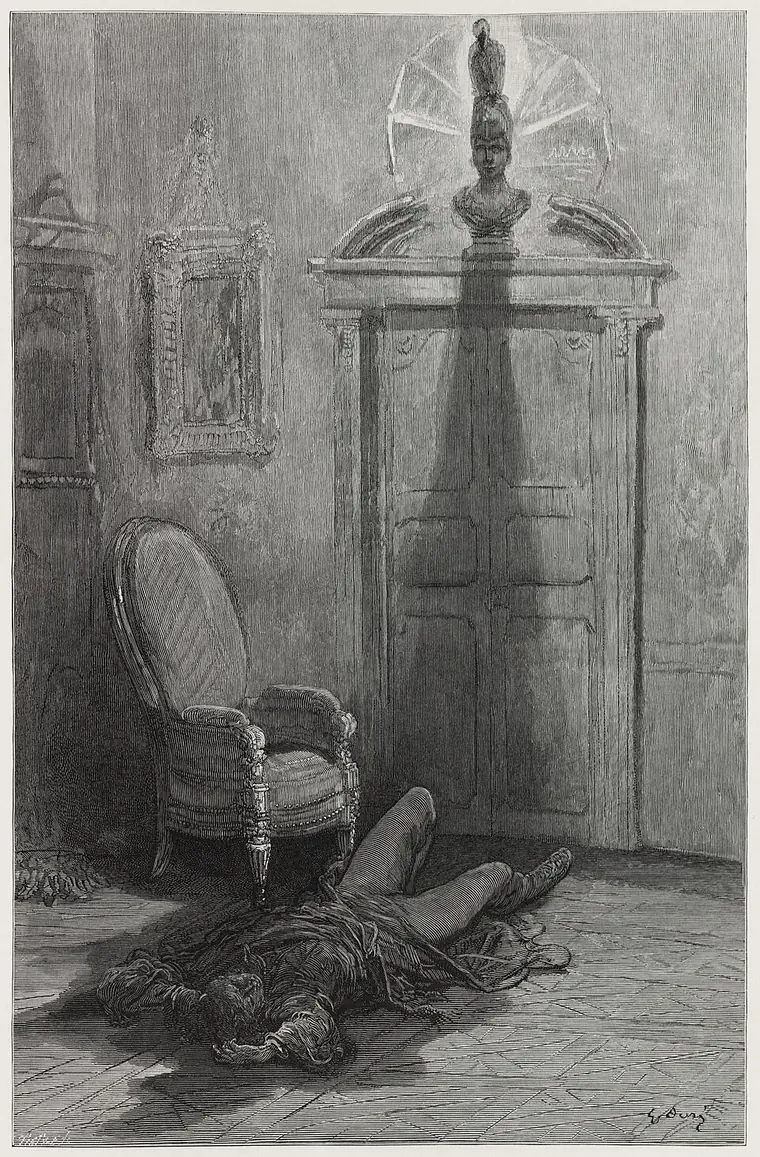
And the raven, never flitting, still is sitting, still is sittingOn the pallid bust of Pallas just above my chamber door;And his eyes have all the seeming of a demon's that is dreaming,And the lamp-light o'er him streaming throws his shadow on the floor;And my soul from out that shadow that lies floating on the floorShall be lifted, nevermore!
The raven is still there, in the lamplight, and the narrator's soul, lying in its shadow, will not be lifted, nevermore.
The famous lines of The Raven
"Once upon a midnight dreary, while I pondered, weak and weary, Over many a quaint and curious volume of forgotten lore"
The opening, and one of the best-known first lines in poetry.
"Quoth the raven, 'Nevermore.'"
The refrain that gives the poem its shape. The raven says only this one word.
"Take thy beak from out my heart, and take thy form from off my door!"
His last cry at the bird, which does not leave.
"And my soul from out that shadow that lies floating on the floor Shall be lifted, nevermore!"
The last lines, in which the raven is still sitting there.
What next?
For the real places in Poe's life, read Poe's Baltimore: the house, the grave and the mystery of his death. For other lines to read aloud, Halloween quotes from classic gothic novels, and for more gothic reads gothic novels: where to start and 15 to read next.
New editions in 2026 include Renard Press's The Raven with The Philosophy of Composition, illustrated with Edouard Manet's art, published on 15 June 2026 (confirmed from the publisher's page).
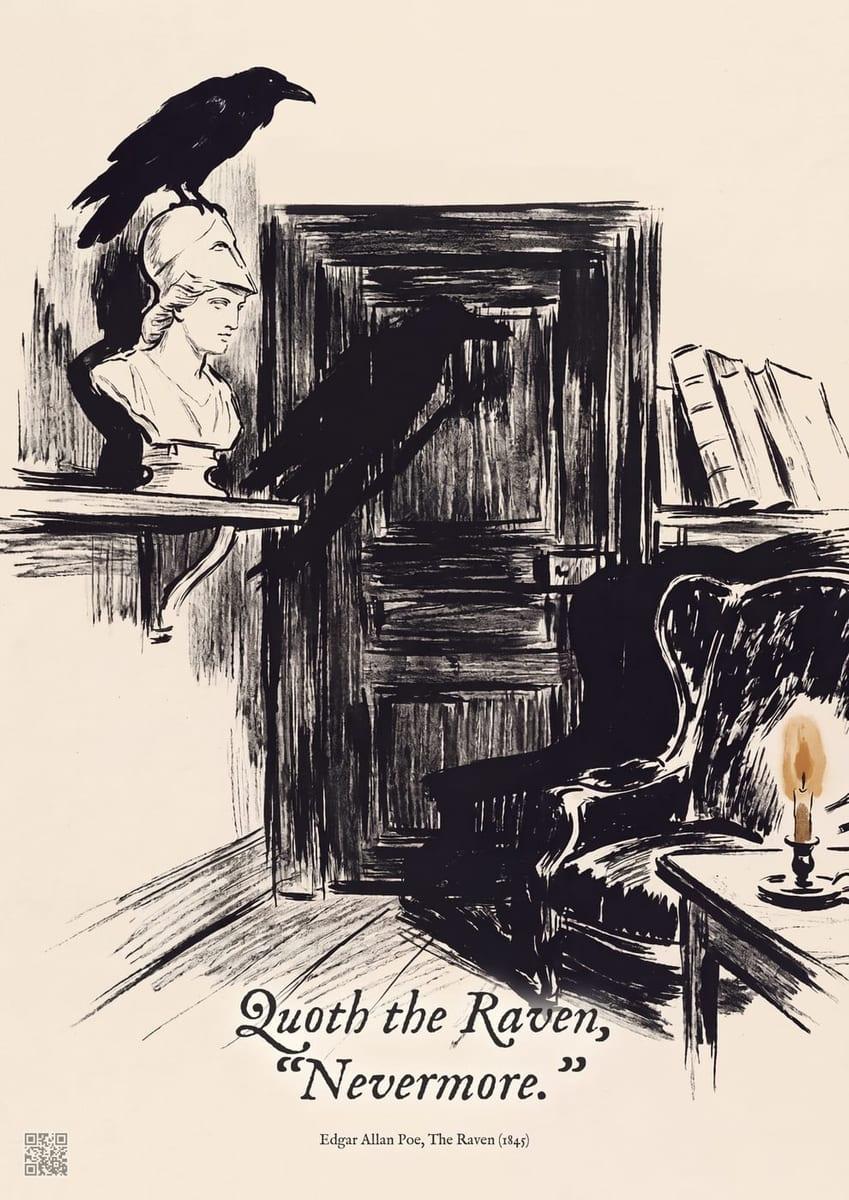
The Raven print
More from the gothic hub
- Up: the gothic and horror hub, with the prints, bookmarks, news, facts and a map for Coraline, Wuthering Heights, Dracula and the Phantom.
- Next: Poe's Baltimore.
- Next: New and special gothic editions in 2026.
- Shop: Gothic and Horror art prints.
Sources (3)
All read on 20 November 2026 and written up here in our own words.
- Wikipedia: The Raven, publication, inspiration and meter.
- Wikisource: The Raven and Other Poems, the 1845 text.
- Renard Press: The Raven, the 2026 Manet edition.
Worth following
More gothic and horror, from places we like. Tap a title, then a name.
Places, festivals and sitesWhere the stories happened, and where fans gather
Bronte Parsonage MuseumThe Haworth home of the Bronte sisters
 Photo: DeFacto, CC BY-SA 4.0, via Wikimedia Commons
Museum
The museum describes itself as the home of the famous Bronte sisters. It is the house they grew up in, and the place to learn the story of the writers behind Wuthering Heights and Jane Eyre.
Open the Bronte Parsonage Museum ↗Opens in a new tab. Independent of Chapter & Scene.
Whitby Abbey (English Heritage)Haunting Gothic ruins above Whitby
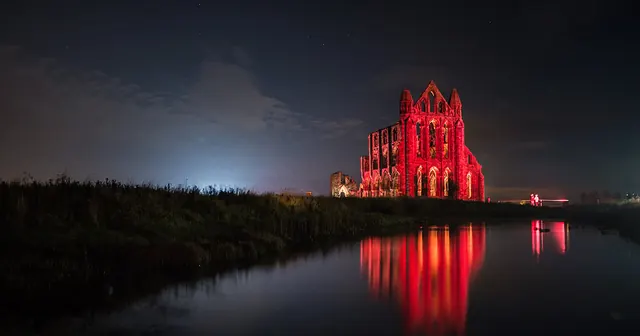
Heritage site
English Heritage's own page for the abbey, which it describes as haunting Gothic ruins high above Whitby. Check it before you plan a visit.
Open the Whitby Abbey page ↗Opens in a new tab. Independent of Chapter & Scene.
Whitby Goth WeekendA goth music festival, founded in 1994
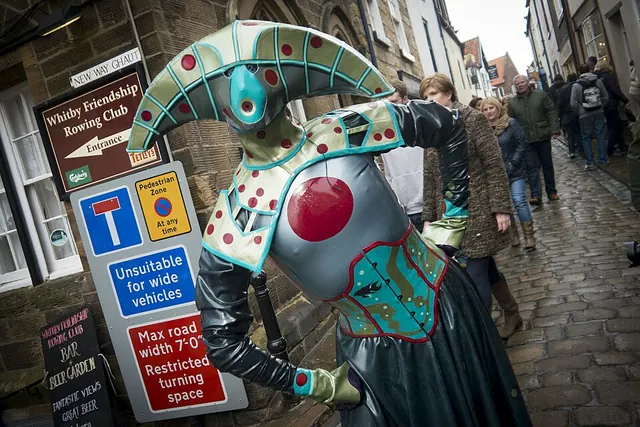 Photo: Bryan Ledgard, CC BY 2.0, via Wikimedia Commons
Festival
The festival says it is an alternative music festival, founded in 1994, that has grown into one of the world's premier goth events. Wikipedia adds that it is held twice a year.
Open the Whitby Goth Weekend site ↗Opens in a new tab. Independent of Chapter & Scene.
Dracula DailyThe novel, emailed to you in real time

Newsletter
A Substack that emails you the classic novel Dracula in real time, as the events happen. A gentle way to read it slowly.
Open Dracula Daily ↗Opens in a new tab. Independent of Chapter & Scene.
PodcastsFor the commute, the walk or the washing up
BacklistedA books podcast from two readers

Podcast
A books podcast presented by John Mitchinson and Andy Miller, good company for classic and older reads.
Open Backlisted ↗Opens in a new tab. Independent of Chapter & Scene.
PseudoPodHorror fiction, read aloud
Podcast
A horror fiction podcast. Its own page calls it the sound of horror.
Open PseudoPod ↗Opens in a new tab. Independent of Chapter & Scene.
Free audiobooksPublic domain recordings by volunteers
Dracula (LibriVox)About 16.5 hours, read by volunteers
Free audiobook
A free recording by LibriVox volunteers, running 16 hours 31 minutes. LibriVox notes its recordings are public domain in the USA.
Open it on LibriVox ↗Opens in a new tab. Independent of Chapter & Scene.
Wuthering Heights (LibriVox)About 11.5 hours, read by volunteers
Free audiobook
A free recording by LibriVox volunteers, running 11 hours 33 minutes.
Open it on LibriVox ↗Opens in a new tab. Independent of Chapter & Scene.
Frankenstein, 1818 text (LibriVox)About 8 hours, read by Cori Samuel
Free audiobook
A free recording of the 1818 text of Frankenstein read by Cori Samuel, running 7 hours 59 minutes.
Open it on LibriVox ↗Opens in a new tab. Independent of Chapter & Scene.
Questions
When was The Raven published?
In January 1845. It was first attributed to Poe in print in the New York Evening Mirror on 29 January 1845.
What inspired The Raven?
Wikipedia says it was inspired in part by a talking raven in Dickens's 1841 novel Barnaby Rudge.
How many stanzas does The Raven have?
Eighteen, each of six lines, in the 1845 text.
Who is Lenore?
The narrator's lost love, whose death he is grieving on a December night. She is never described beyond a rare and radiant maiden whom the angels name Lenore.